Ajit Singh of Cambridge and Chandigarh by Ashwani Saith
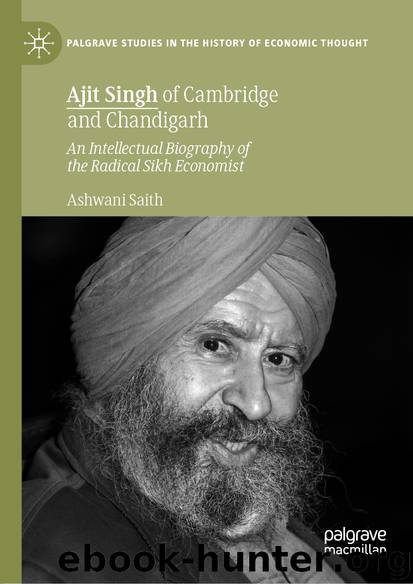
Author:Ashwani Saith
Language: eng
Format: epub
ISBN: 9783030124229
Publisher: Springer International Publishing
China and India: Socialism and Industrialisation
In the spring of 1973, Ajit, accompanied by fellow Cambridge economist, Suzy Paine , travelled to China , then deep in the tumultuous throes of the Cultural Revolution , and visited various state and collective enterprises. Shanghai , the industrial heartland, was a political hot, if not the hottest, spot in China, the habitat of the Gang of Four , the epicentre of Maoist politics directed against the “capitalist roaders” following the Liu Shao-Chi line. Ajit and Suzy entered this fray at the Shanghai Diesel Engine Factory. The outcome of the field investigation is recorded in their joint paper written immediately after the visit (Paine and Singh 1973)34; they delve into the ramifications of the “two line struggle” as expressed on the shop floor: “the essence of the question was one of power: power to determine whether the factory should be run according to Mao’s or to Liu Shao-Chi’s line; whether politics or profits should be ‘in command’; whether moral or material incentives should dominate; whether the factory should be run by a handful of ‘experts’ or whether workers should also participate in management and management in physical labour” (Paine and Singh 1973, p. 1).
While they stayed clear of waving Maoist banners, the authors’ empathetic position vis-à-vis “the socialist roaders” is not difficult to gauge from the nature of the questions and issues they pursued in their reported interviews. They concluded, “in this factory, more than in any other we visited, there were clearly people with sufficient political experience and awareness who would actually be able to lead a struggle against the recurrence of ‘revivalist’ tendencies. We had the unmistakable impression that the Cultural Revolution had been a thoroughgoing and deeply-felt experience in this factory” (ibid., p. 9).
This resonates with Ajit’s discussion at the end of his methodical, detailed analysis of the economic performance of socialist China in another paper, published in 1973 though written in 1972 clearly in preparation for the field visit to China the following year.35 Ajit suggested “that the Maoist model of development — with its emphasis on reducing economic, social and status differentials and on mass participation — has important implications not only for other socialist countries and for the underdeveloped countries, but also for the developed capitalist countries of Europe and North America” (Singh 1973, pp. 2108–2109). He emphasised the significance Mao attached to the role of ideas, citing that “ideas, once they are correctly grasped by the masses, can become a motive force in history” (ibid., p. 2108). Although Ajit favoured a Mao jacket for quite a while after returning from China to Cambridge, his (few) publications on pre-Reforms China (Singh 1973, 1975b) were rightly carefully qualified with regard to the reliability of statistics and, though clearly sympathetic, were far from any form of Maoist “whateverism”.
Barring these few stand-alone articles on China in its early Maoist phase, it is noteworthy that Ajit wrote only occasionally on the Chinese experience per se, though what he wrote was substantively significant.
Download
This site does not store any files on its server. We only index and link to content provided by other sites. Please contact the content providers to delete copyright contents if any and email us, we'll remove relevant links or contents immediately.
International Integration of the Brazilian Economy by Elias C. Grivoyannis(111315)
The Radium Girls by Kate Moore(12093)
Turbulence by E. J. Noyes(8113)
Nudge - Improving Decisions about Health, Wealth, and Happiness by Thaler Sunstein(7758)
The Black Swan by Nassim Nicholas Taleb(7195)
Rich Dad Poor Dad by Robert T. Kiyosaki(6727)
Pioneering Portfolio Management by David F. Swensen(6341)
Man-made Catastrophes and Risk Information Concealment by Dmitry Chernov & Didier Sornette(6138)
Zero to One by Peter Thiel(5864)
Secrecy World by Jake Bernstein(4798)
Millionaire: The Philanderer, Gambler, and Duelist Who Invented Modern Finance by Janet Gleeson(4538)
The Age of Surveillance Capitalism by Shoshana Zuboff(4352)
Skin in the Game by Nassim Nicholas Taleb(4306)
The Money Culture by Michael Lewis(4267)
Bullshit Jobs by David Graeber(4249)
Skin in the Game: Hidden Asymmetries in Daily Life by Nassim Nicholas Taleb(4051)
The Dhandho Investor by Mohnish Pabrai(3825)
The Wisdom of Finance by Mihir Desai(3788)
Blockchain Basics by Daniel Drescher(3633)
